AI-native product design · IGX · 2026

Squad
Health

Rebuilding a legacy survey flow into a continuous health check—where honest team signals become shared commitments and visible learning across iterations.

Role
Product designer
Scope
Product framing · interaction
design · AI-native build
Status
Launched in Garage practices
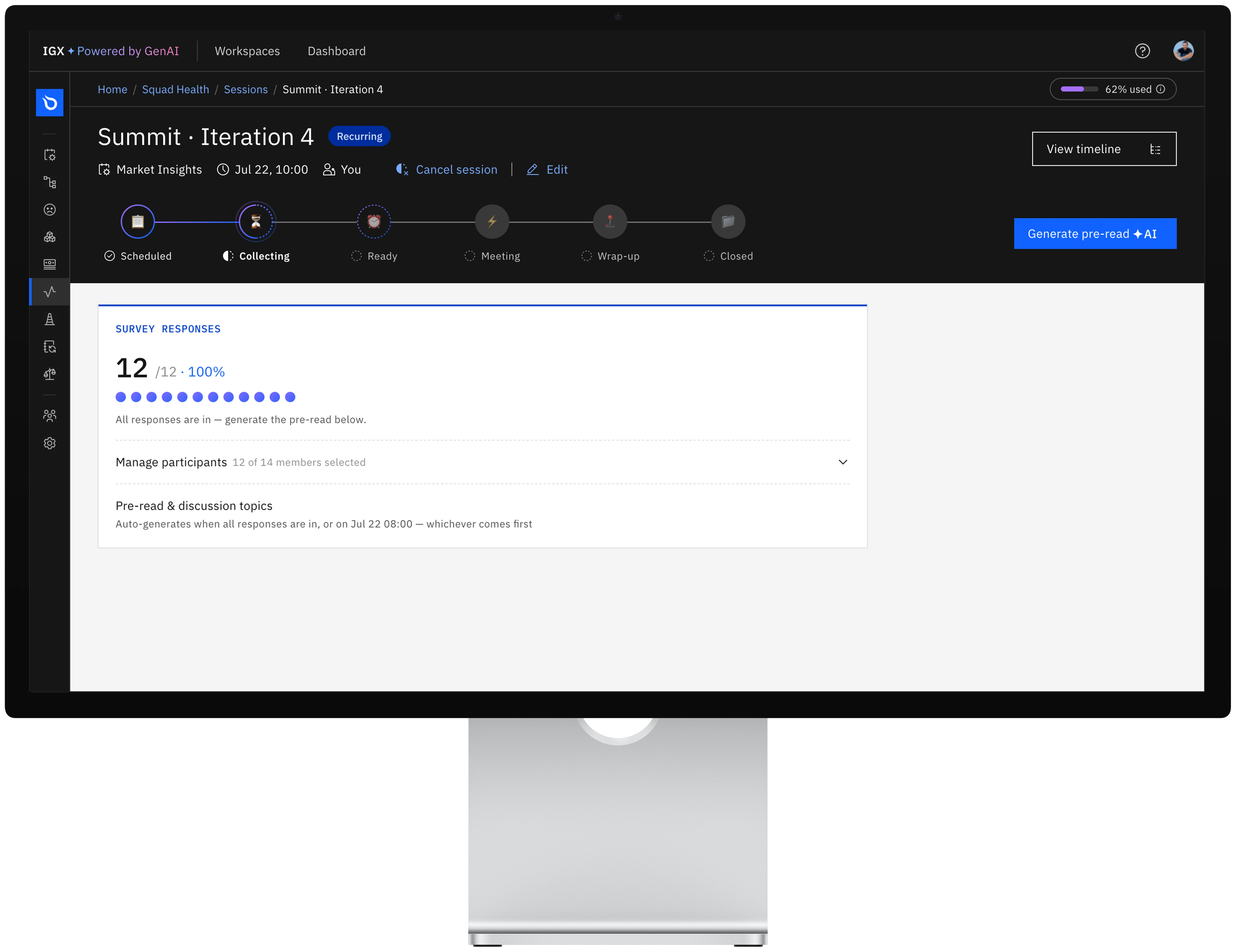
Squad Health retrospective session with responses ready for an AI-assisted pre-read
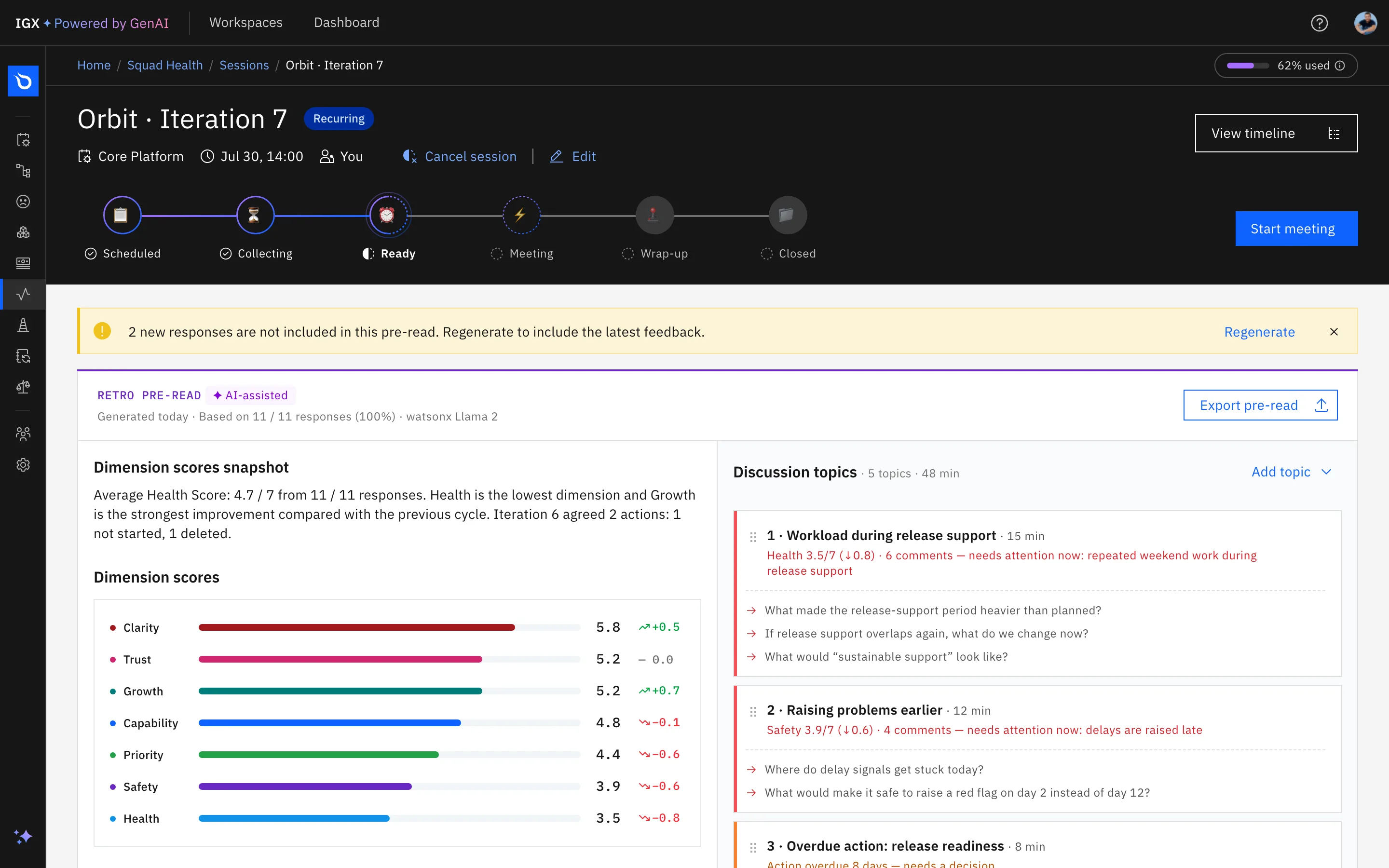
AI-assisted pre-readSurface team patterns before the conversation starts.

Project snapshot

The team.The timeframe.The handoff.

Role
Product designer — led research, positioning, design, and the AI-native build end to end.
Timeline
24 Jun–5 Aug 2026 · six weeks of design, then handed to development.
Team
Feedback research with one fellow UX designer · design & build: me, with an AI coding agent + Figma MCP · review gates: delivery team (PM, architects, technical leads), PO, and IBM DT Coaches.
Status
Greenlit after three review gates · prototype codebase, specifications, design guidelines, and AI prompts handed to development · now launched in Garage practices.

My role

As the product designer, I reframed a legacy survey flow into a trusted retrospective workflow—one that turns honest signals into decisions, actions, and learning for the next iteration.

I owned

  • Research synthesis and reframing: turning feedback into design principles, then moving Squad Health from score reporting to a retrospective loop with follow-through.
  • The end-to-end experience model: anonymous signals, AI pre-read, facilitated discussion, reviewed outcomes, and owned actions across one lifecycle.
  • Figma key frames, the design language, and trust moments: privacy and invitation cues, AI clarification, plus empty and failure states.
  • The AI-native build loop: design contract, quality review, and the developer-ready handoff of specifications, interaction rules, guidelines, and AI prompts.

I collaborated on

  • Feedback research and validation with one fellow UX designer and the client’s Garage coach team.
  • Aligning the workflow with existing IGX practices, directing the AI-assisted prototype build, and reviewing it across three gates with the delivery team, PO, architects, technical leads, and IBM DT Coaches.

Outcome

Cleared three multidisciplinary review gates, then handed to development as a traceable set of code, specifications, guidelines, and AI prompts. Squad Health is now launched in Garage practices for Garage coach teams.

IBM Garage method · IGX

Squad Health is not a standalone survey. It is where iteration learning becomes operational.

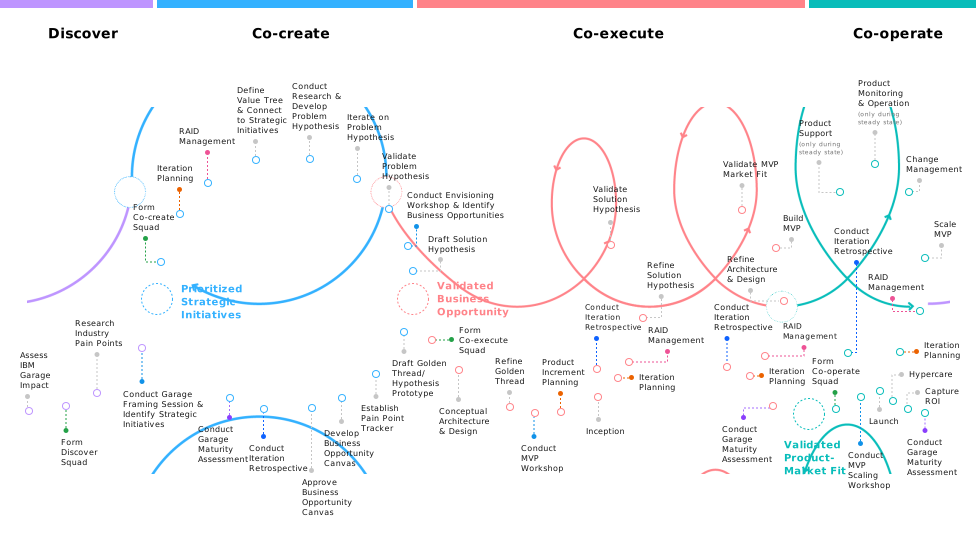
From 2024 to 2026, I designed evolving parts of IGX: a digital platform for making the IBM Garage way of working visible and actionable. Squad Health supports Conduct Iteration Retrospective, connecting the learning during delivery with the operating rhythm that follows it.

Garage methodIGXConduct Iteration RetrospectiveSquad Health
IBM Garage methodology showing Conduct Iteration Retrospective across Co-create, Co-execute, and Co-operate
Methodology context · the practice runs through Co-create and Co-execute, then continues into Co-operate.

Why the feature had to change

From survey scores to continuous team improvement.

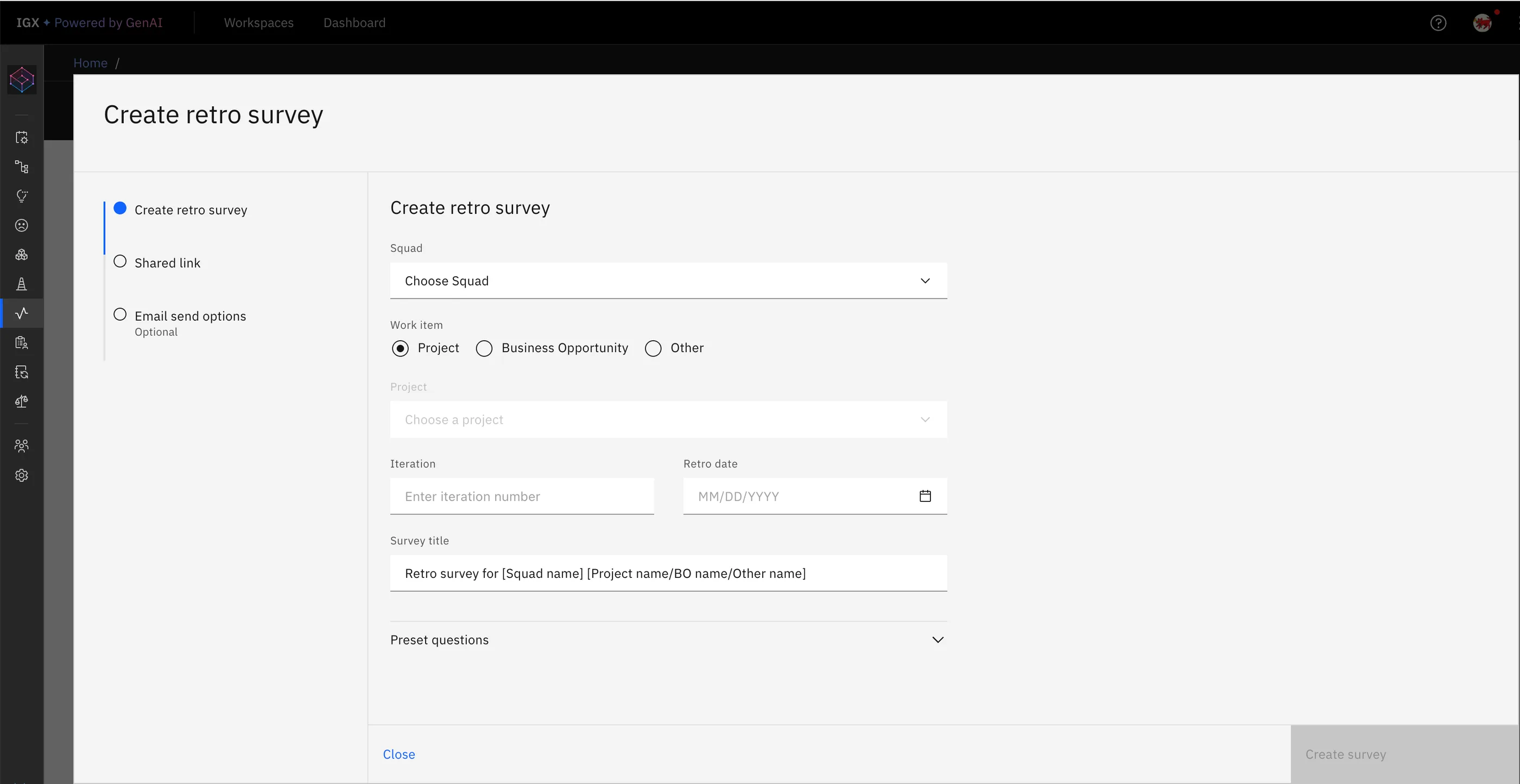
The legacy survey

Create, send, count

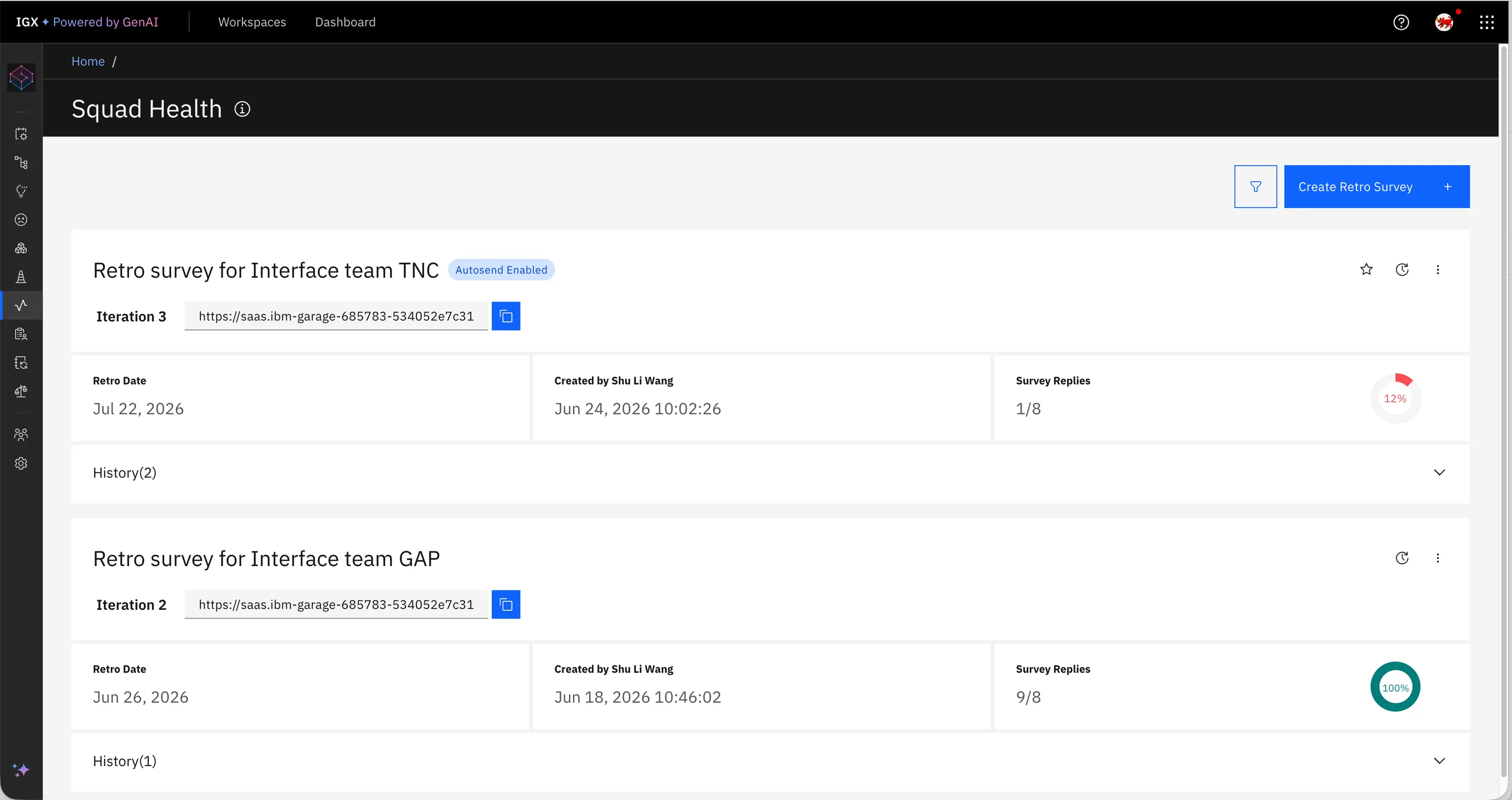
  • A facilitator created a survey for an iteration, then shared its link with the squad.
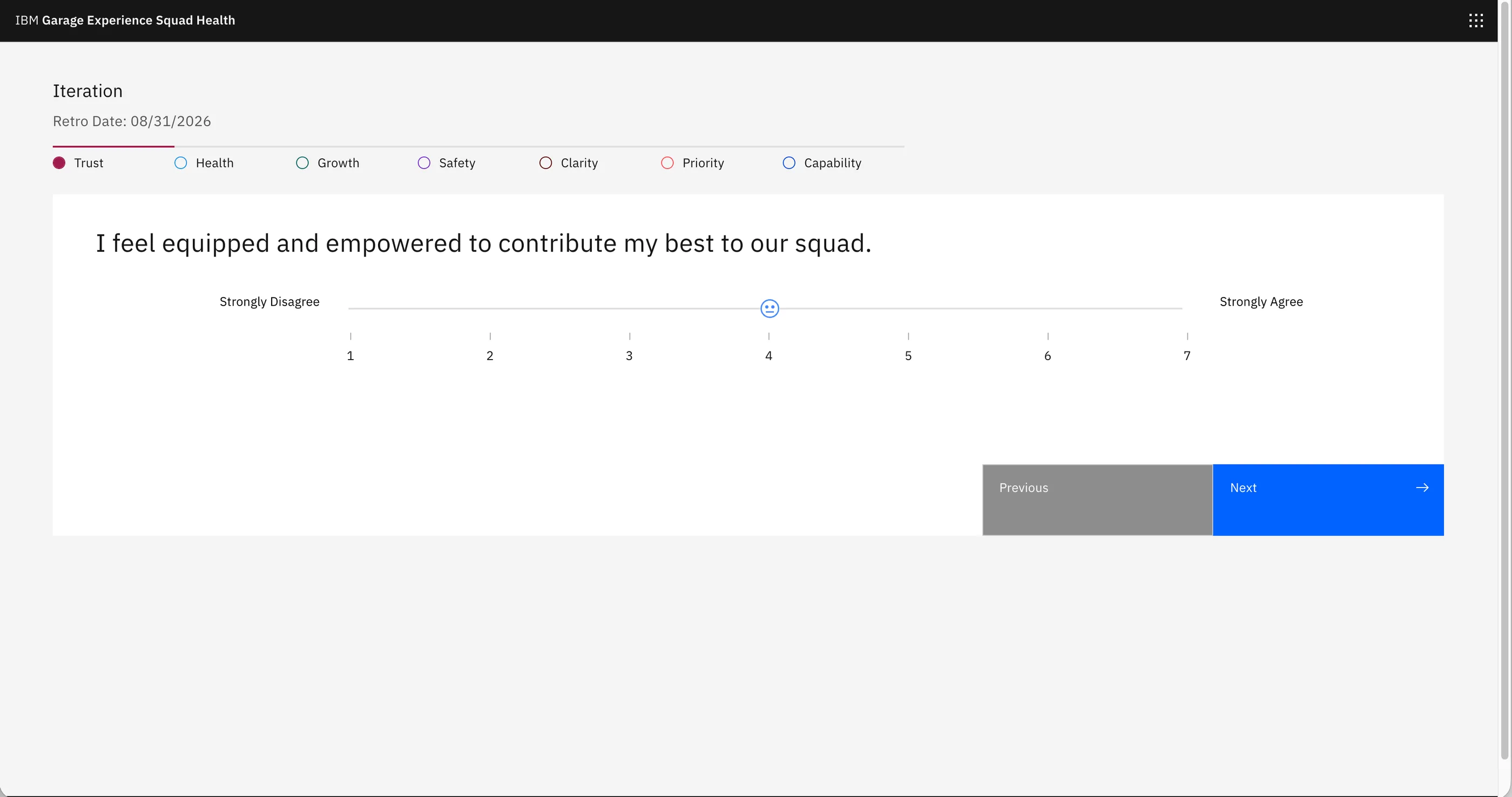
  • Members submitted anonymous 1–7 responses; the system surfaced reply counts and dimension scores.
  • Discussion, reports, and action follow-up happened elsewhere, without a connected next step.
The Squad Health check

Signal, prepare, decide, carry forward

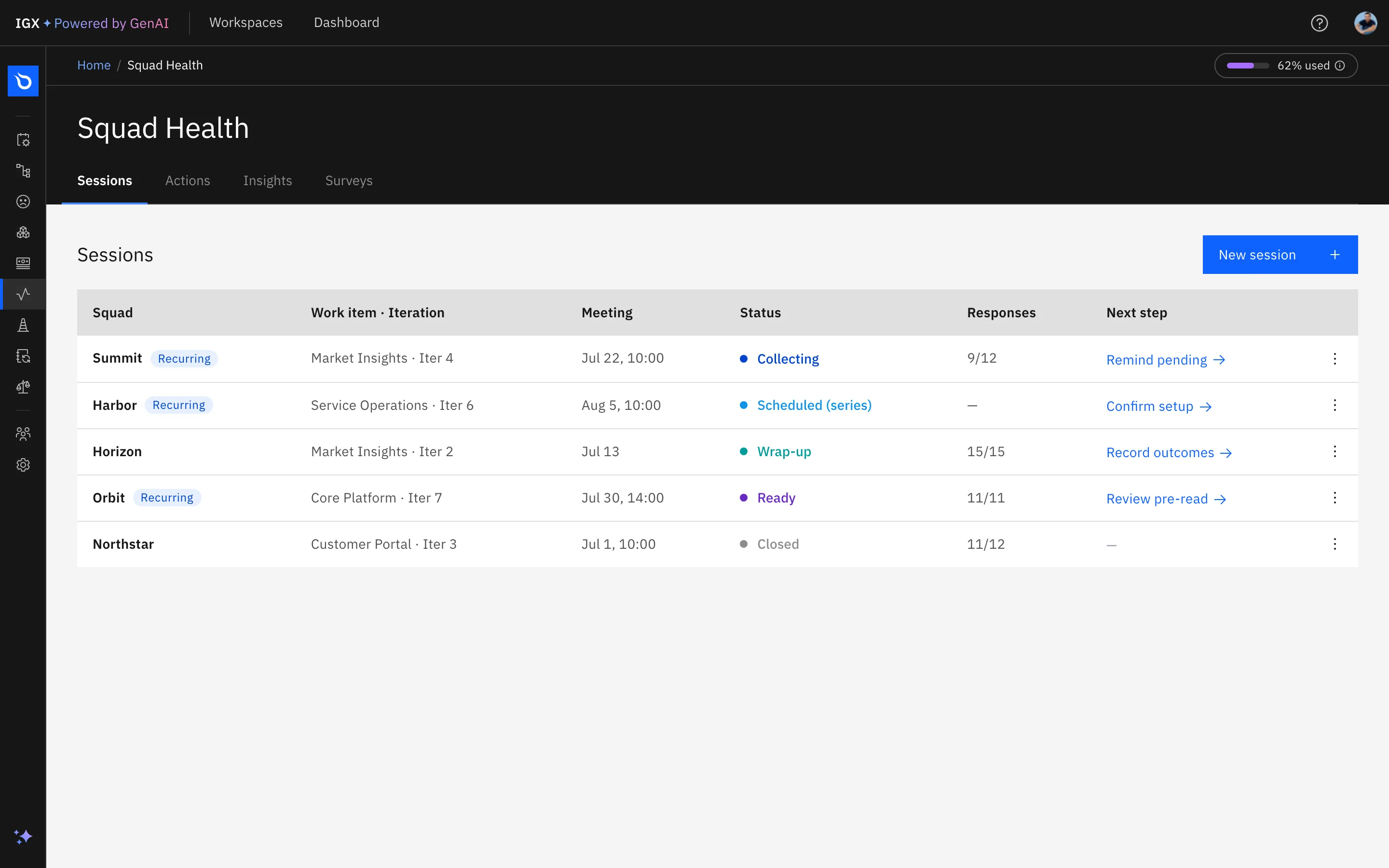
  • Set up one iteration session, collect anonymous signals, then prepare a reviewable AI pre-read.
  • Guide the retrospective from reflection through grouping, voting, discussion, and reviewed outcomes.
  • Turn outcomes into actions with a PIC and due date, then return that history as next-iteration context.

Garage coach team · initial input

The ask was not a better survey. It was structured follow-through and learning across iterations.

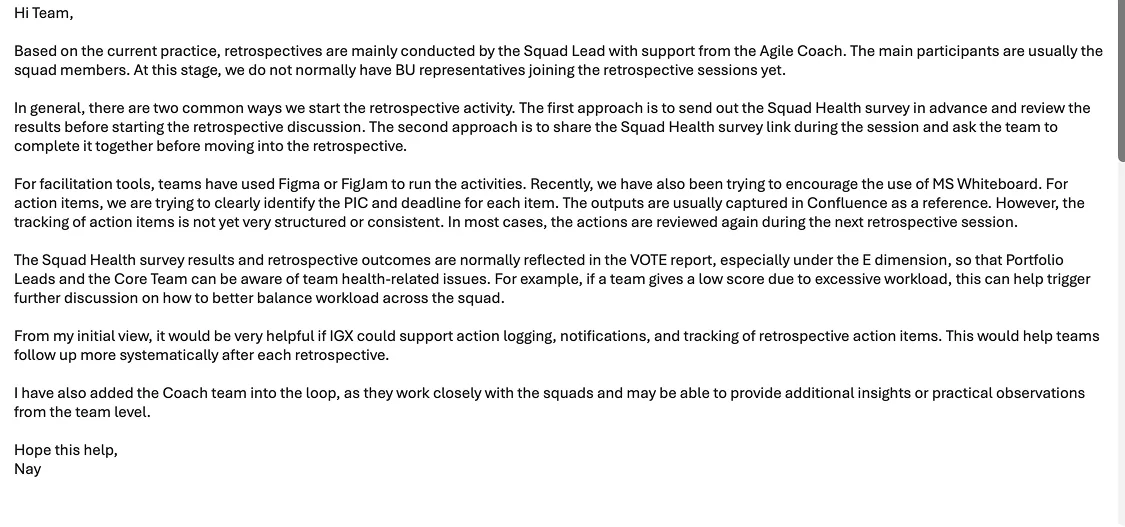
The original email thread made the gap explicit: the survey stopped at responses and scores, while reports, workshops, action tracking, and retrospective context lived elsewhere.

Existing feature · survey

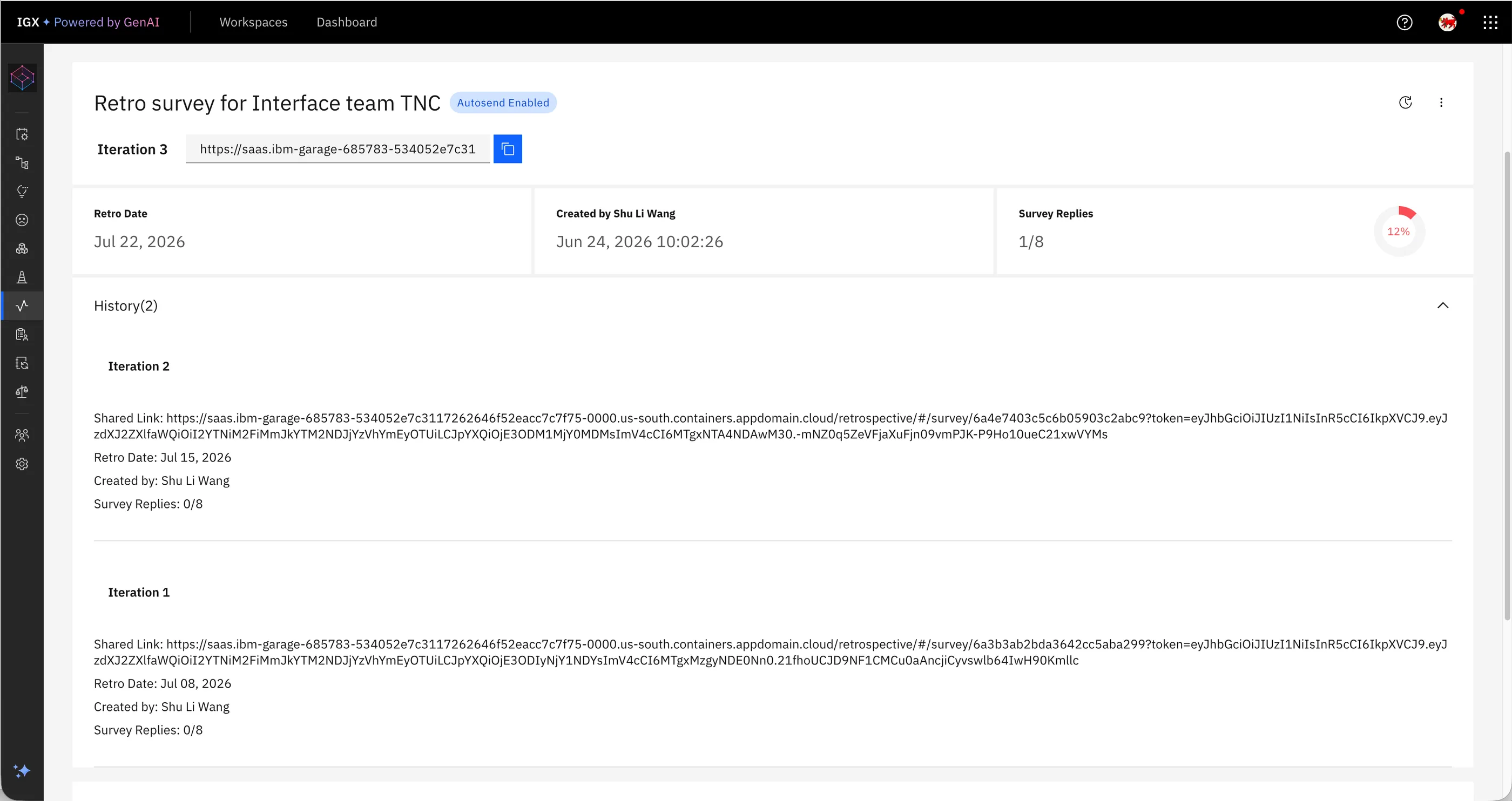
Create → send → respond → count

  1. Legacy Squad Health three-step form for creating a retrospective survey
    01Create
  2. Legacy Squad Health list of retrospective survey cards with shared survey links
    02Send
  3. Legacy Squad Health member survey showing a one-to-seven scale response
    03Respond
  4. Legacy Squad Health auto-send survey history showing earlier rounds and reply counts
    04Count

What the Garage coach team asked IGX to support

Their request reframed the work from collecting a survey to helping teams turn signals into learning and accountable change.

“IGX could support action logging, notifications, and tracking of retrospective action items. This would help teams follow up more systematically after each retrospective.”

Garage coach team · action follow-through

Email excerptOriginal source
Original Garage coach team email requesting action logging, notifications, and tracking
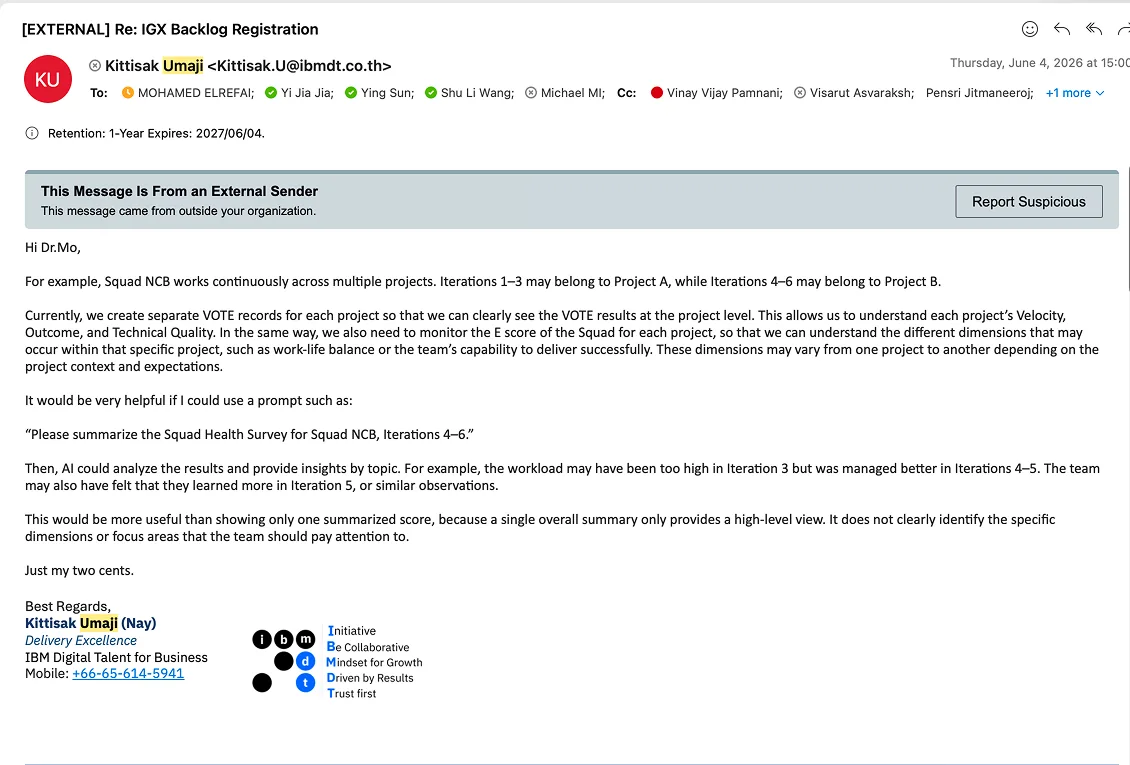
“Please summarize the Squad Health Survey for Squad NCB, Iterations 4–6.” AI could then provide insights by topic, not only one summarized score.

Garage coach team · cross-iteration insight

Email excerptOriginal source
Original Garage coach team email requesting AI insight across several iterations
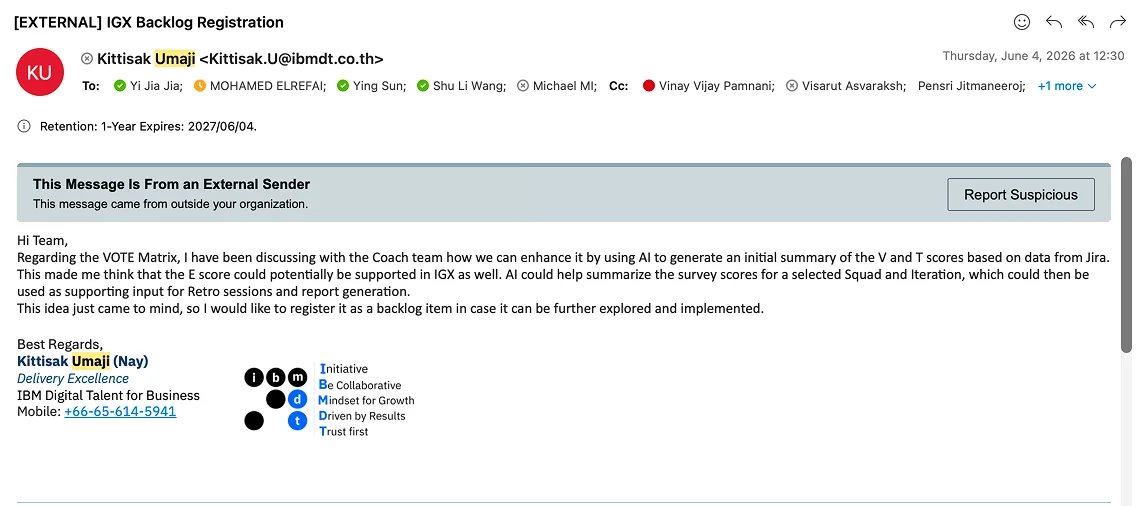
“IGX could support AI to generate an initial summary … used as supporting input for Retro sessions and report generation.”

Garage coach team · AI-assisted preparation

Email excerptOriginal source
Original Garage coach team email requesting AI summaries for retrospective preparation

Current retrospective practice · research evidence

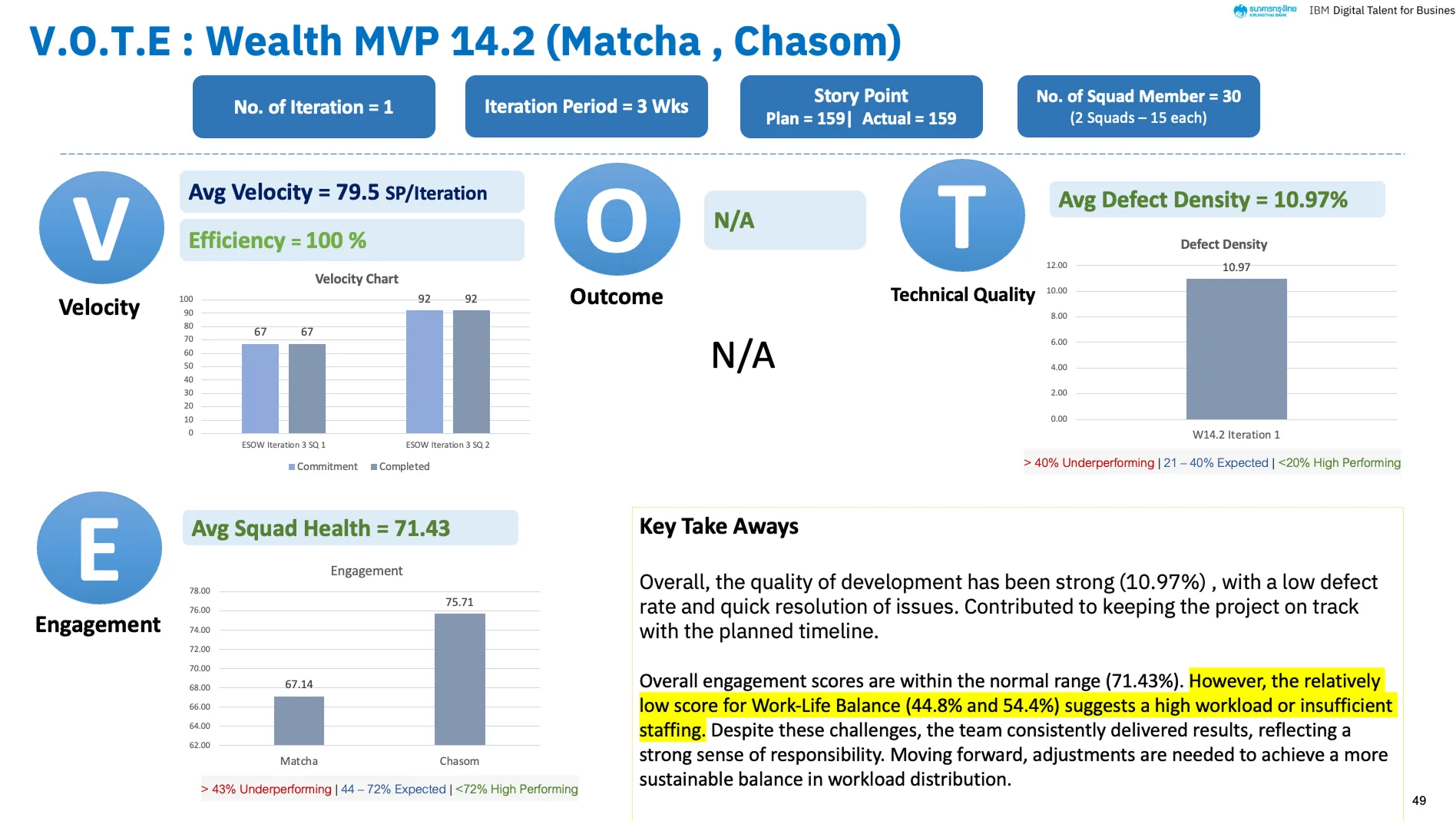
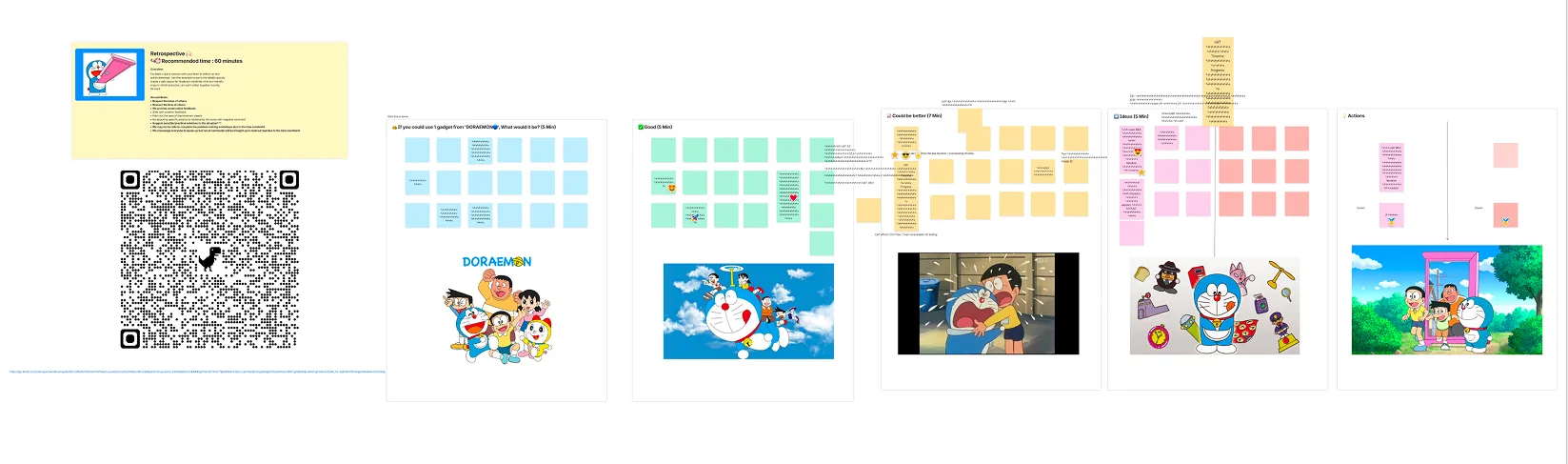
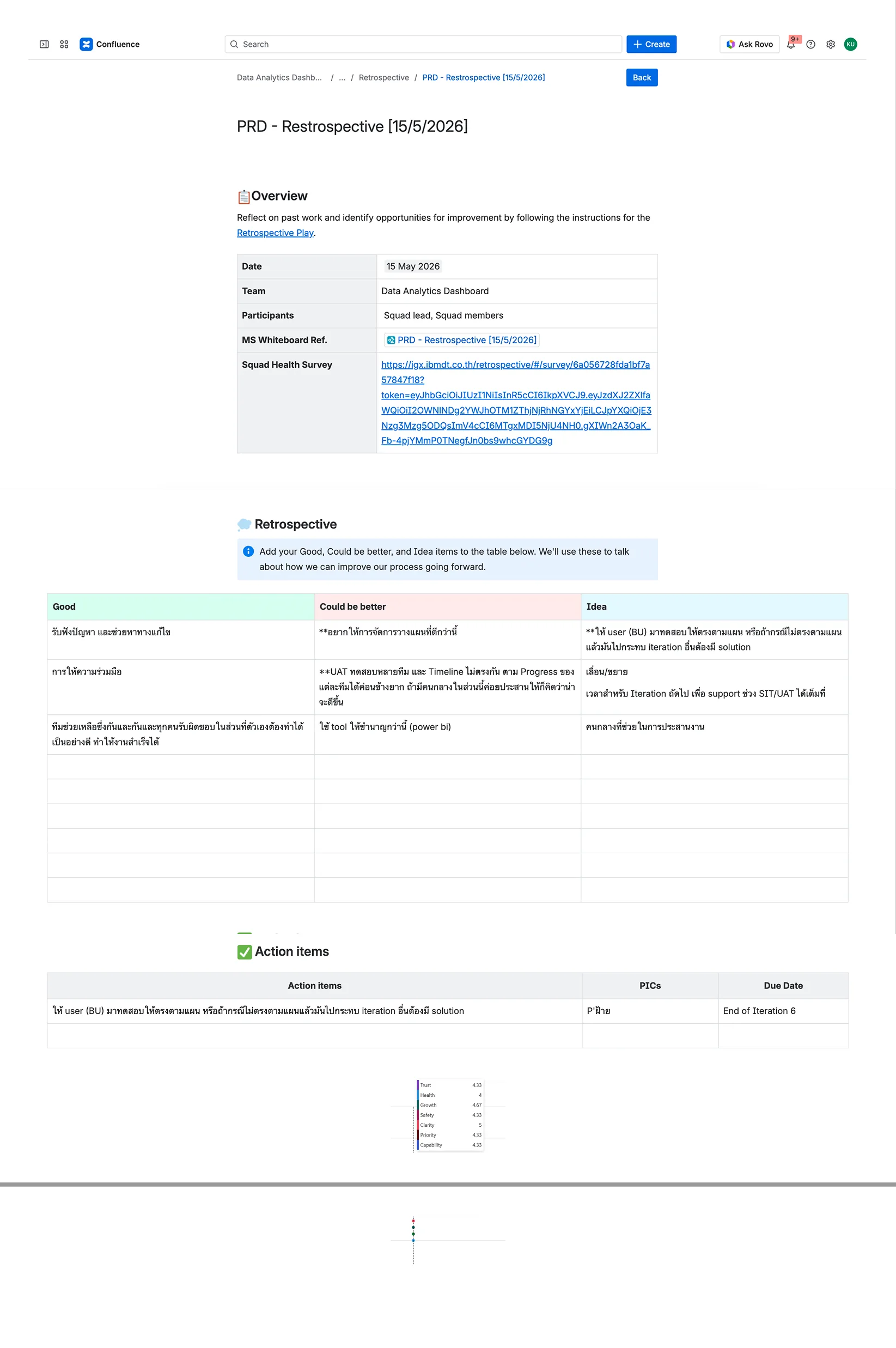
IGX handled survey creation, delivery, and anonymous responses; the rest of the retrospective was split across three places: VOTE reported scores, FigJam hosted the discussion, and Confluence held the record and action items.

  1. 01
    VOTE report

    Scores and takeaways

    Existing VOTE report containing Squad Health results and key takeaways
  2. 02
    FigJam

    Facilitated discussion

    Existing FigJam retrospective board
  3. 03
    Confluence

    Notes and action items

    Existing Confluence retrospective and action items page

From feature request to product questions

The real design problem was the loop around the survey.

I framed the redesign around the four moments where a retrospective can lose trust or momentum. These questions provide the structure for reviewing the legacy experience and gathering evidence before deciding what to build.

  1. 01

    Honesty

    What must be true for a team member to give candid feedback?

  2. 02

    Meaning

    How can a facilitator arrive with context instead of a score to interpret live?

  3. 03

    Decision

    How can a room converge on what to improve without losing the voices behind it?

  4. 04

    Follow-through

    How can a retrospective remain connected to the actions it creates?

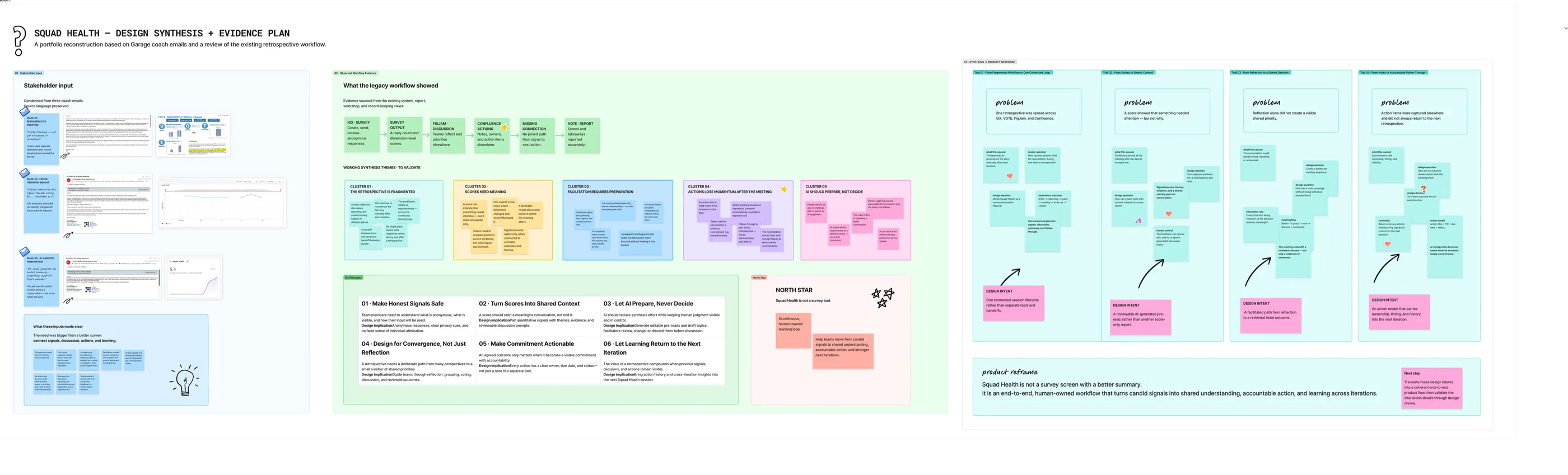
Working synthesis board

Trace the path from stakeholder input to product direction.

I condensed the Garage coach team’s input and reviewed the existing workflow to frame the themes, principles, and design intents that guided Squad Health.

Squad Health design synthesis board linking Garage coach input, workflow evidence, working themes, design principles, and product response
03 · Design synthesisOpen full board ↗

The product architecture

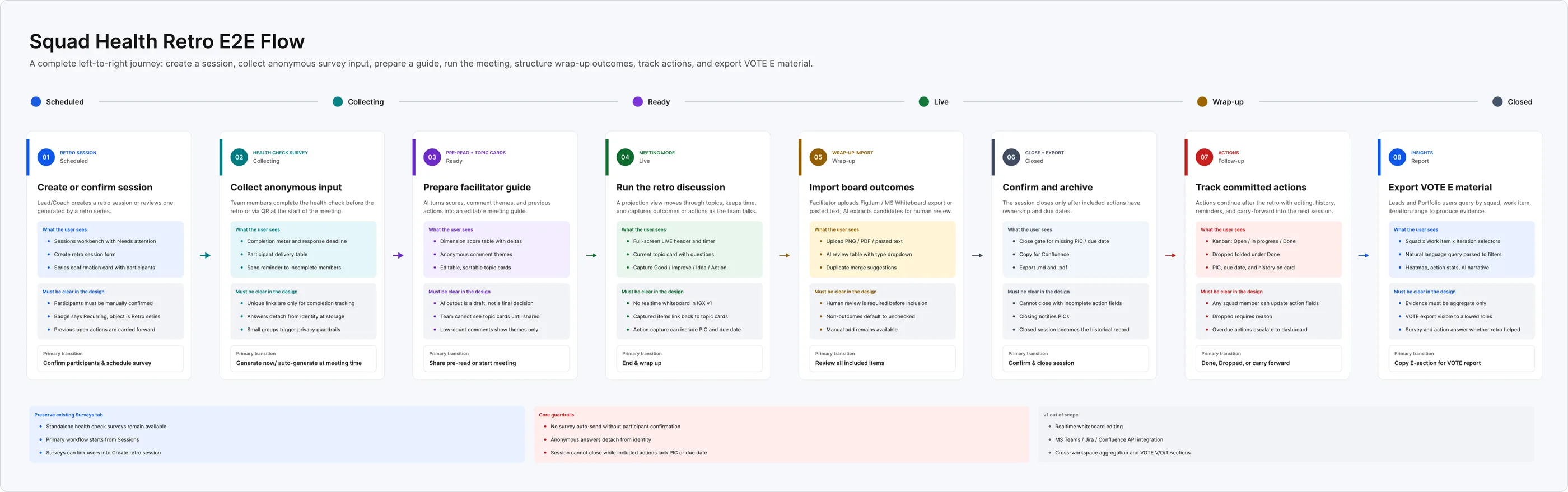
One retrospective, carried from signal to next iteration.

I designed the session as a single record that travels from setup through anonymous signals, preparation, discussion, actions, and the context for what comes next.

End-to-end Squad Health retrospective flow from session setup through survey collection, AI preparation, facilitation, actions, and VOTE reporting
04 · Product lifecycleOpen full flow ↗

From product architecture to working moments

The loop had to work before, during, and after the meeting.

Rather than adding AI to a survey screen, I designed one session record that coordinates creation, scheduled delivery, anonymous collection, facilitation, outcome review, accountable action, and cross-iteration insight.

01 · Set up and collect

Make the survey a scheduled session, not a link someone has to remember.

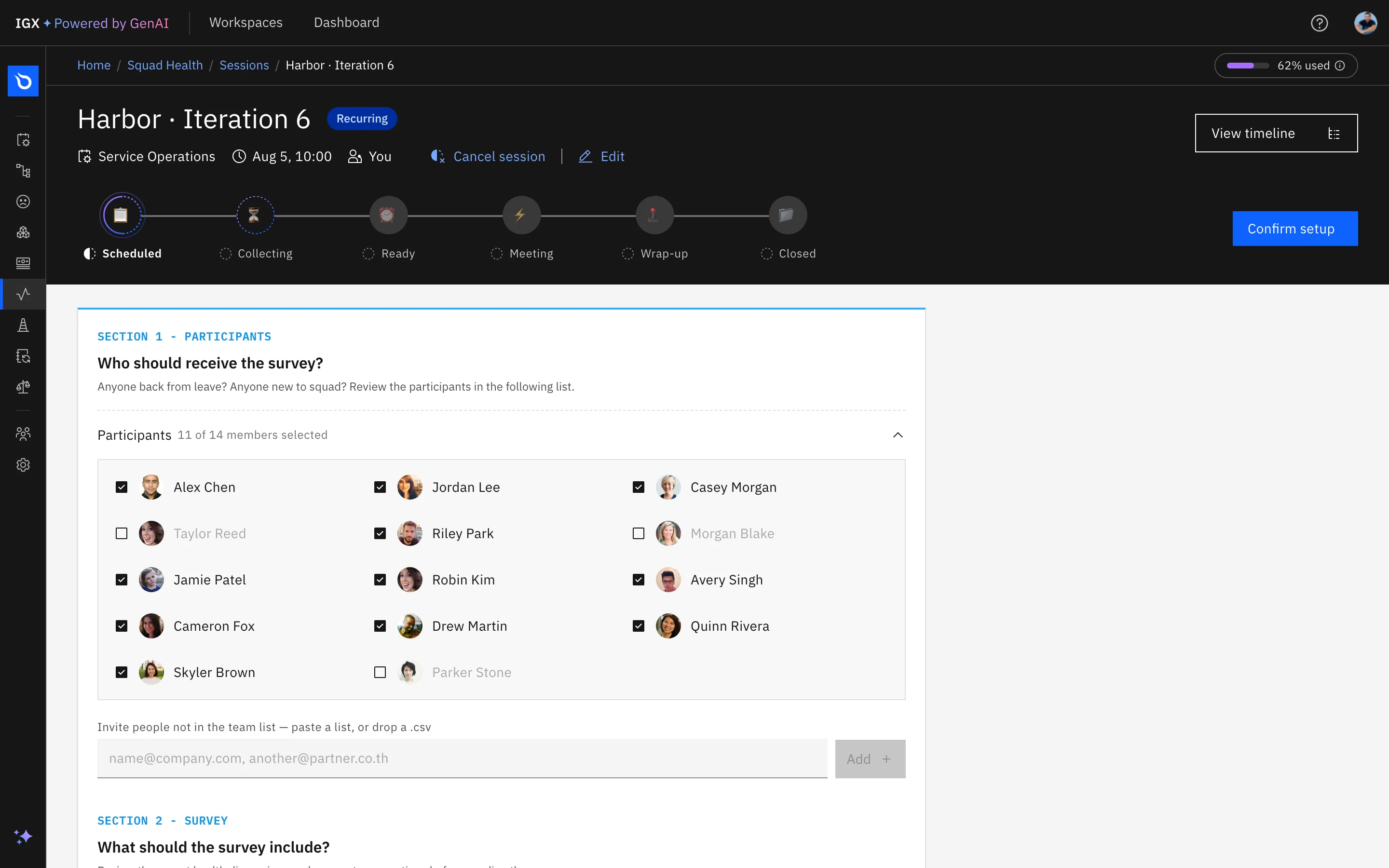
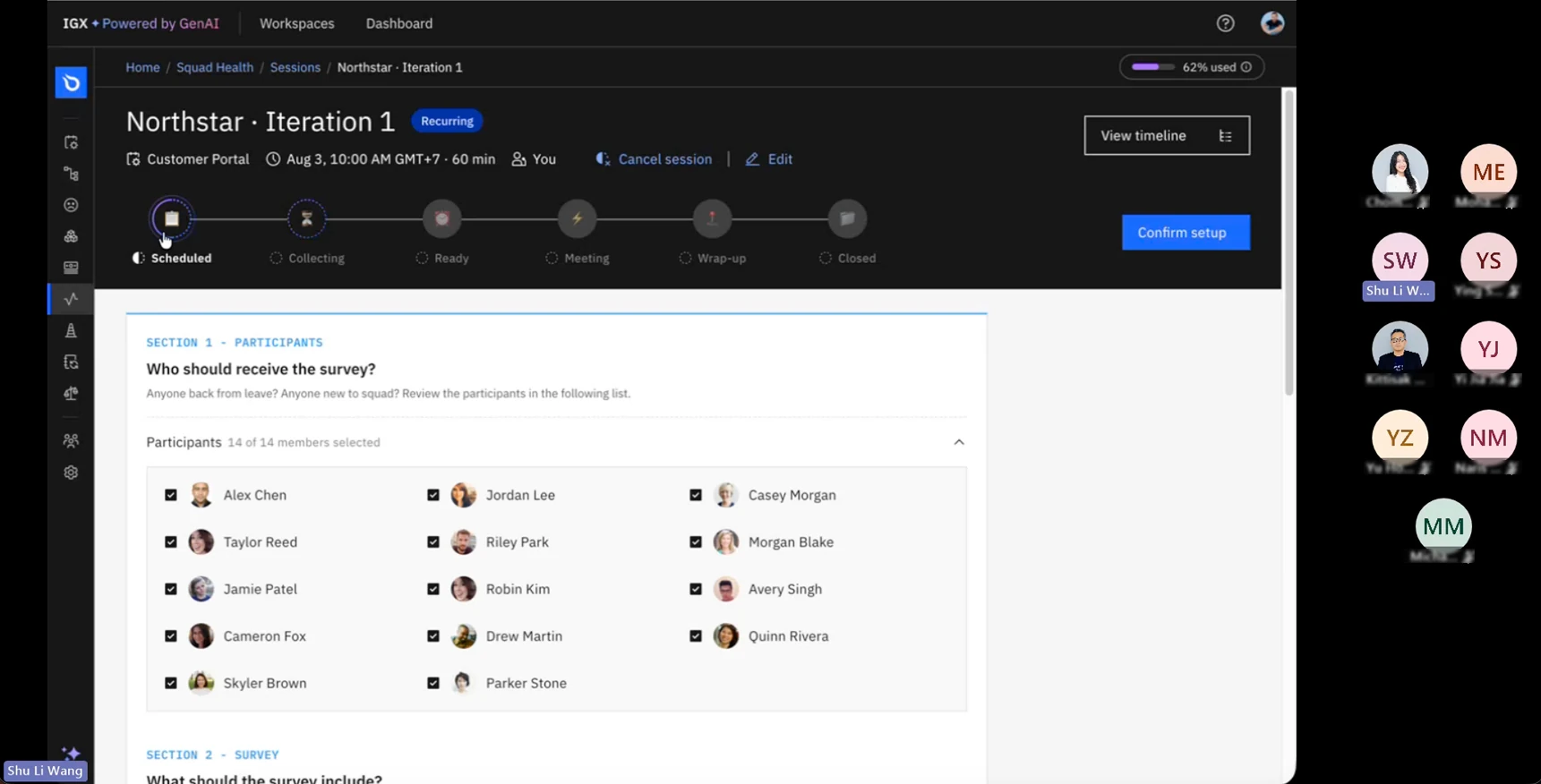
A facilitator chooses the squad, work item, iteration, meeting time, duration, facilitator, participants, and survey. The cycle can be one-off or recurring; the record then carries its own delivery and response state.

  • Schedule the next session and set a recurring cadence when the squad needs one.
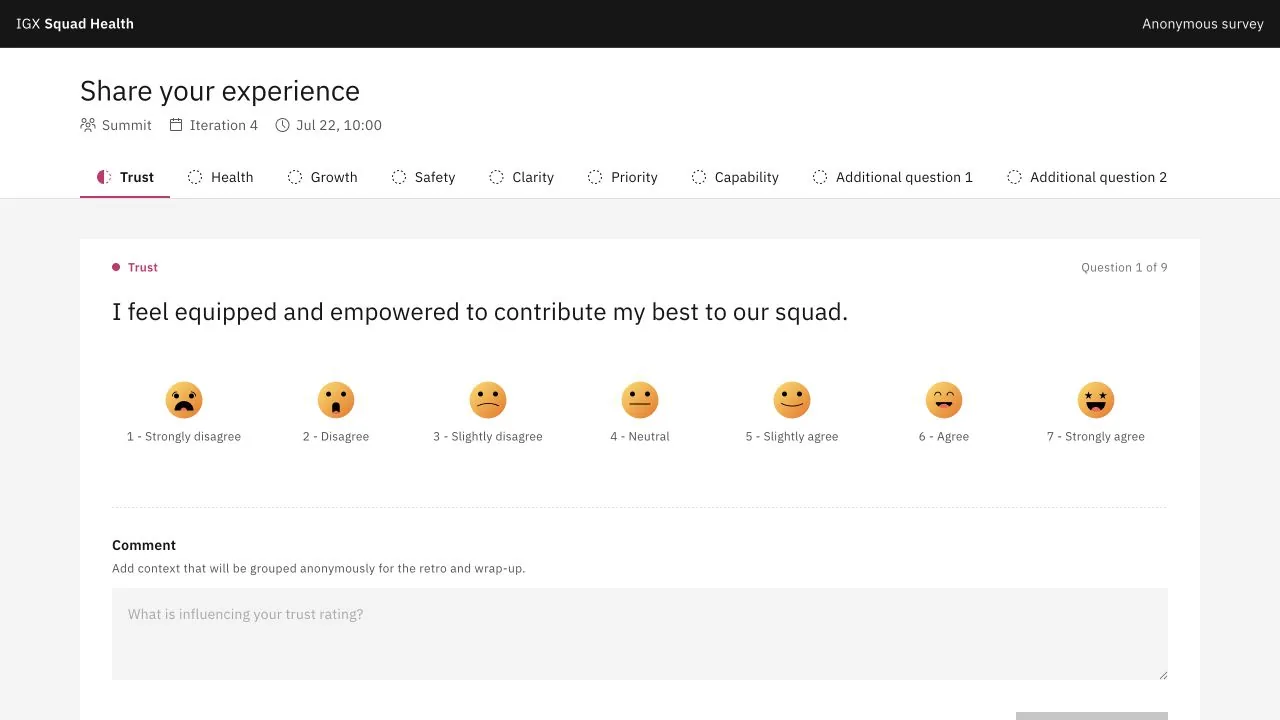
  • Invite a selected participant list to an anonymous member-facing survey.

  • Track completion, send reminders to pending members, and generate the pre-read only when the evidence is ready.
Facilitator flow for setting up a recurring retrospective session with squad, iteration, schedule, participants, and survey
Facilitator setup · schedule, participation, and survey
Member-facing anonymous Squad Health survey
Member response · anonymous signal with context

02 · Prepare and facilitate

Use AI to make the room ready—then let the facilitator lead it.

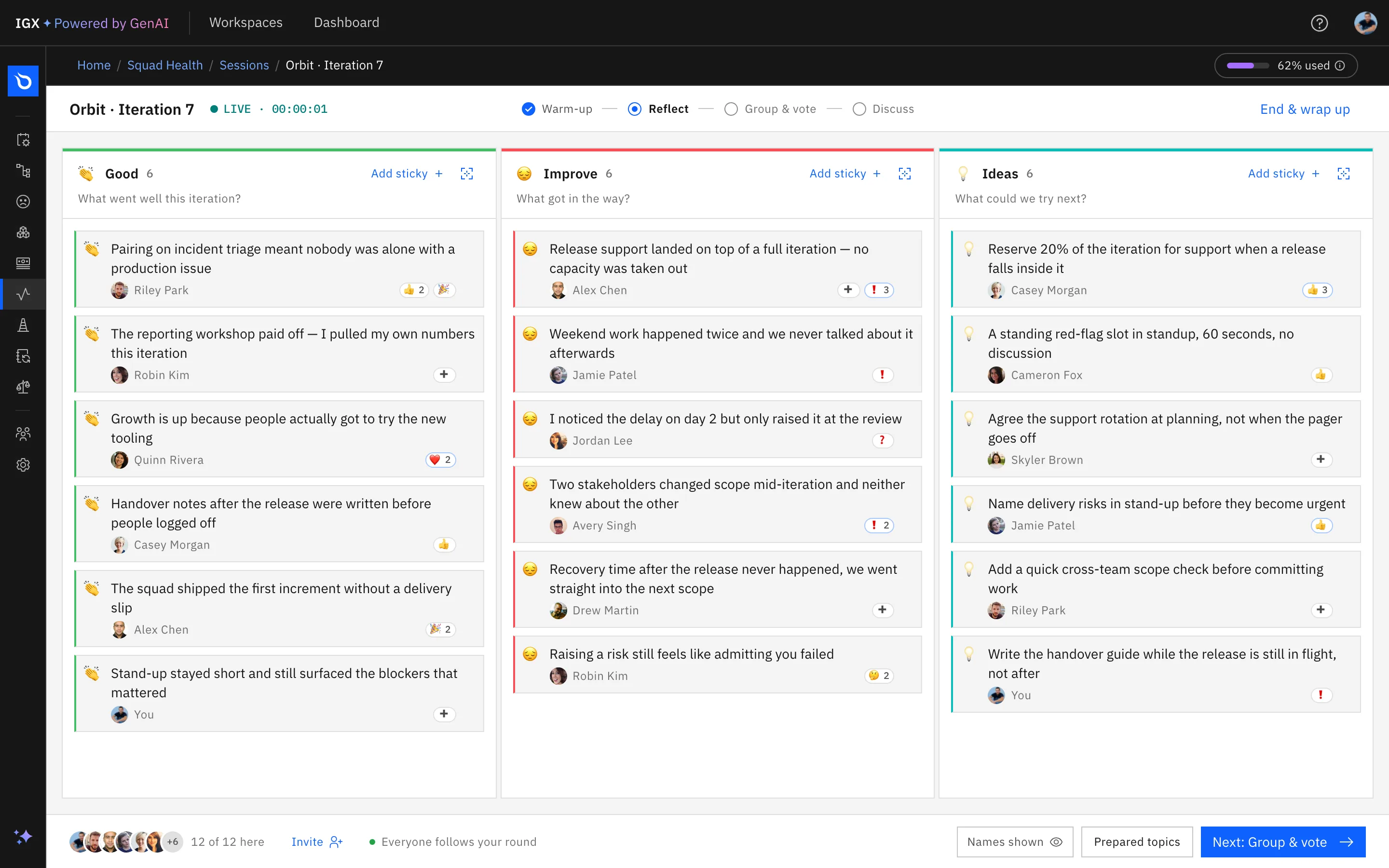
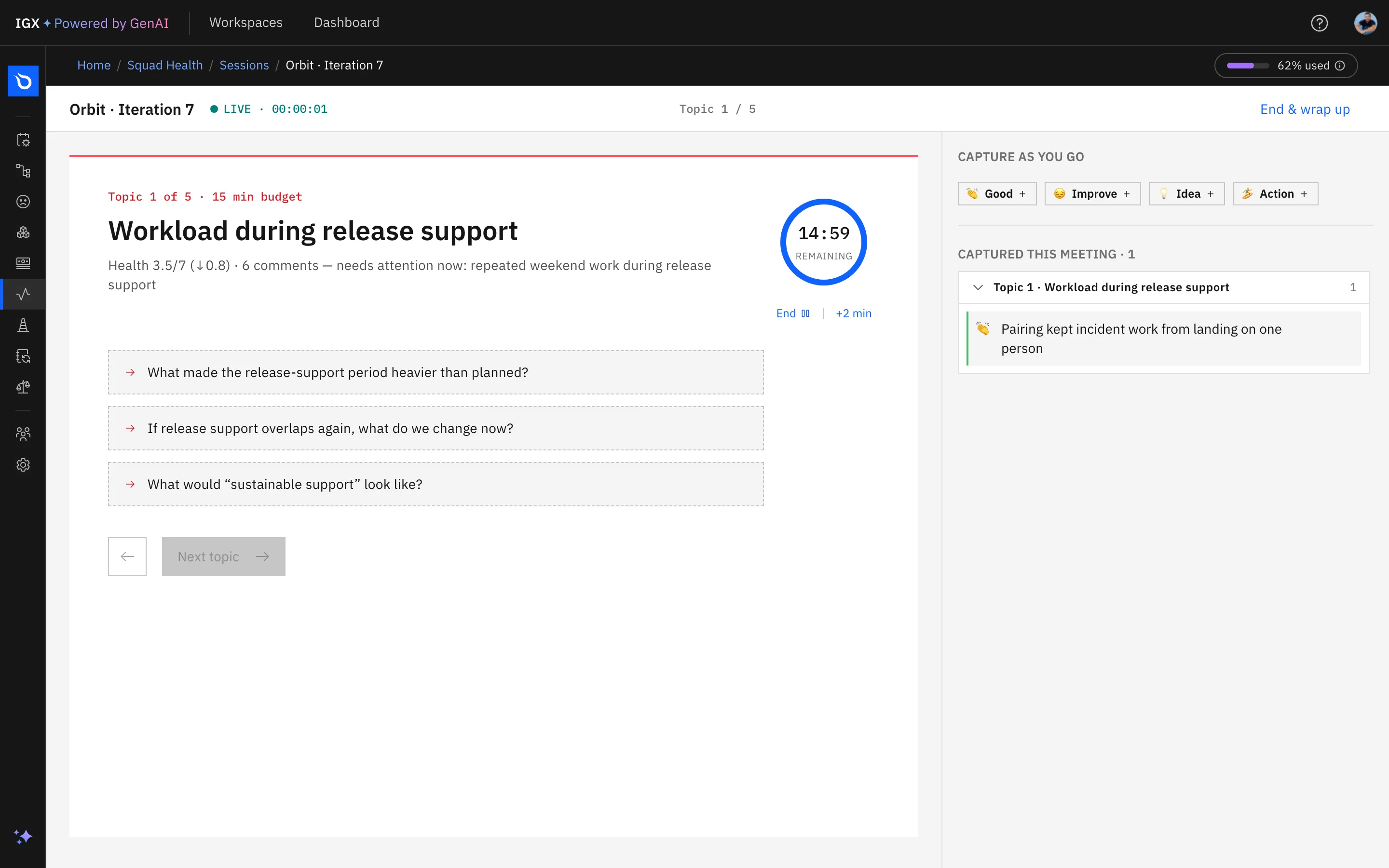
The pre-read turns response coverage, score movement, comments, prior actions, and custom questions into editable discussion topics. At the start of the session, teams choose the meeting space that fits their practice.

  • IGX board: reflect, group, vote, discuss, and carry the working notes forward without an export.
  • Outside IGX: retain FigJam, Mural, MS Whiteboard, or a notes-only practice while IGX keeps the agenda and timer.
  • Bring the external board or supporting material back at wrap-up; AI drafts outcomes, but the facilitator reviews what is kept.
AI-assisted pre-read showing response coverage, score movement, comment themes, previous actions, and discussion topics
AI pre-read · a prepared agenda, not an AI verdict
Start meeting dialog offering an IGX board or an external whiteboard such as FigJam, Mural, or MS Whiteboard
Meeting choice · work inside IGX or preserve an existing board
Example external whiteboard export with Good, Improve, Ideas, and Actions columns
External material · accepted as wrap-up evidence

03 · Review, act, and learn

Turn the conversation into an owned next step—and make its pattern visible beyond one meeting.

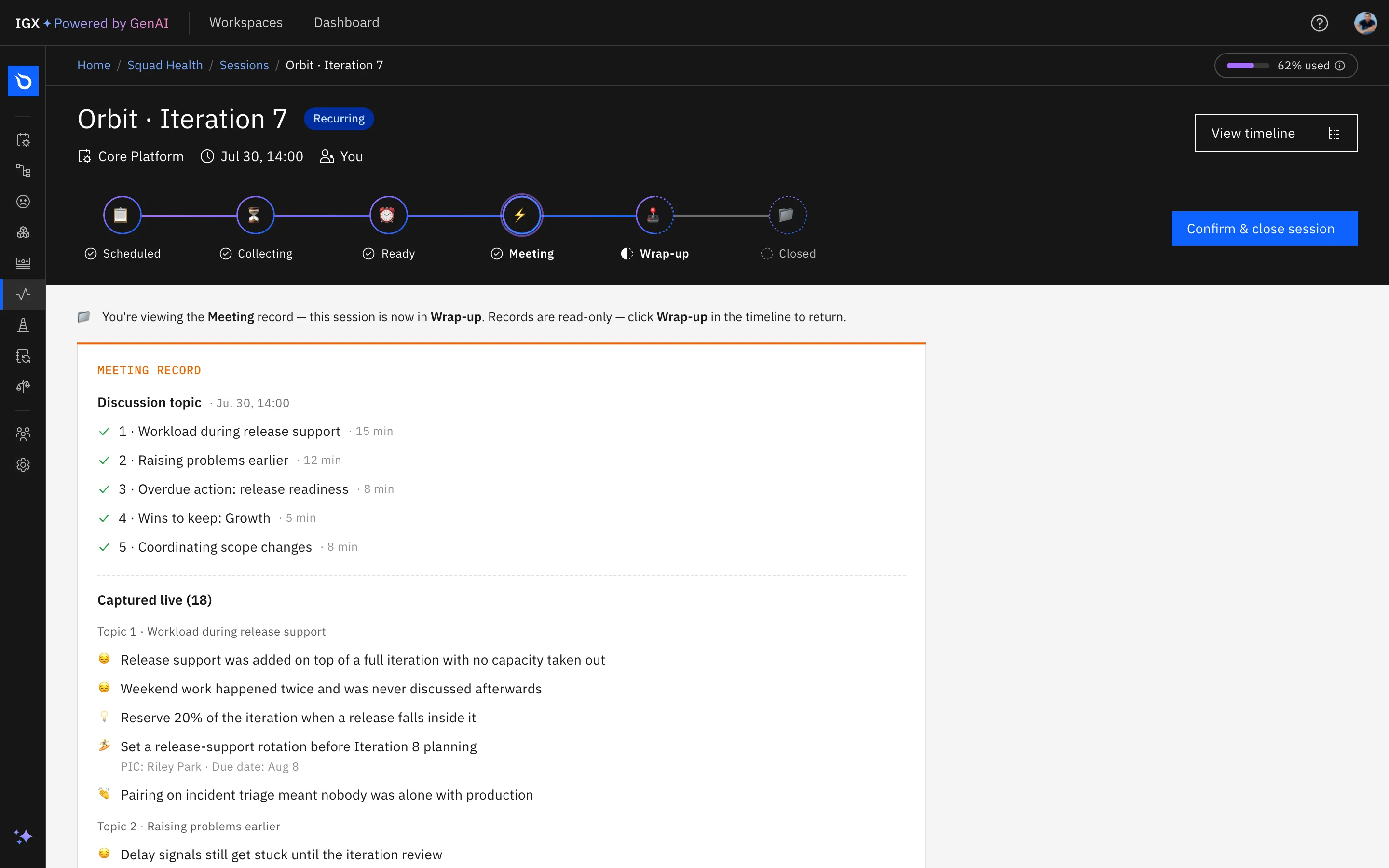
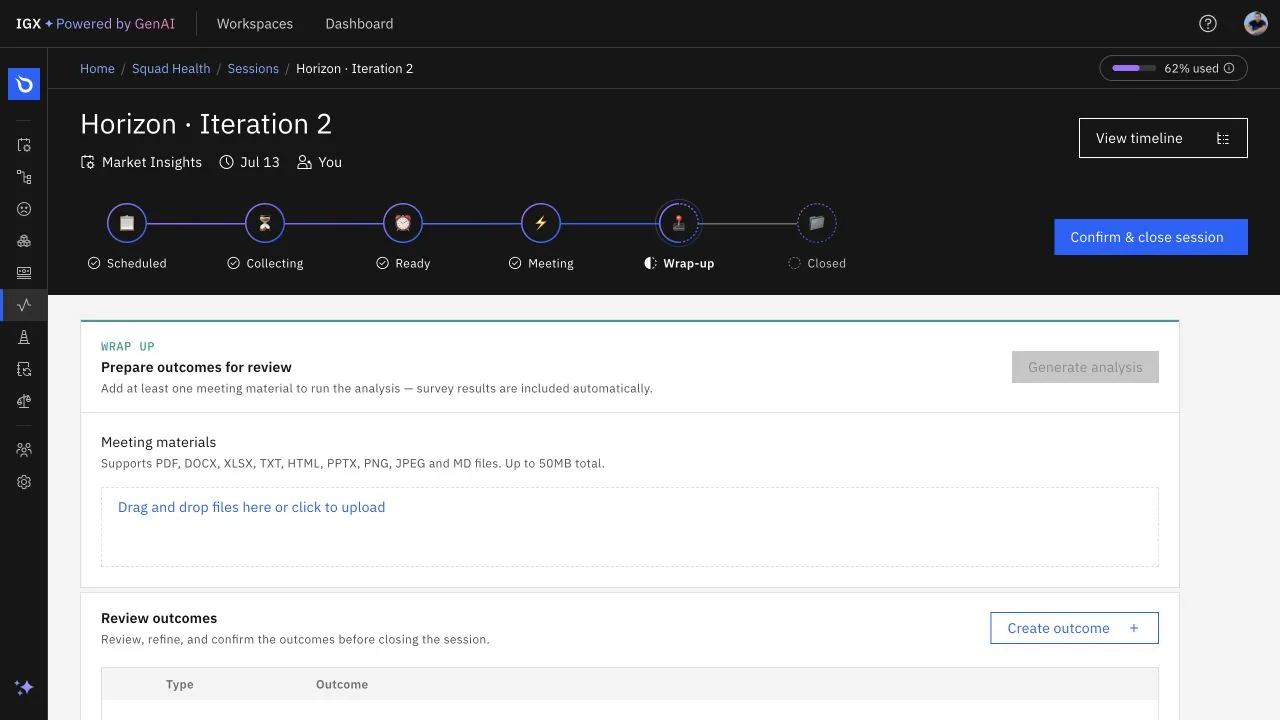
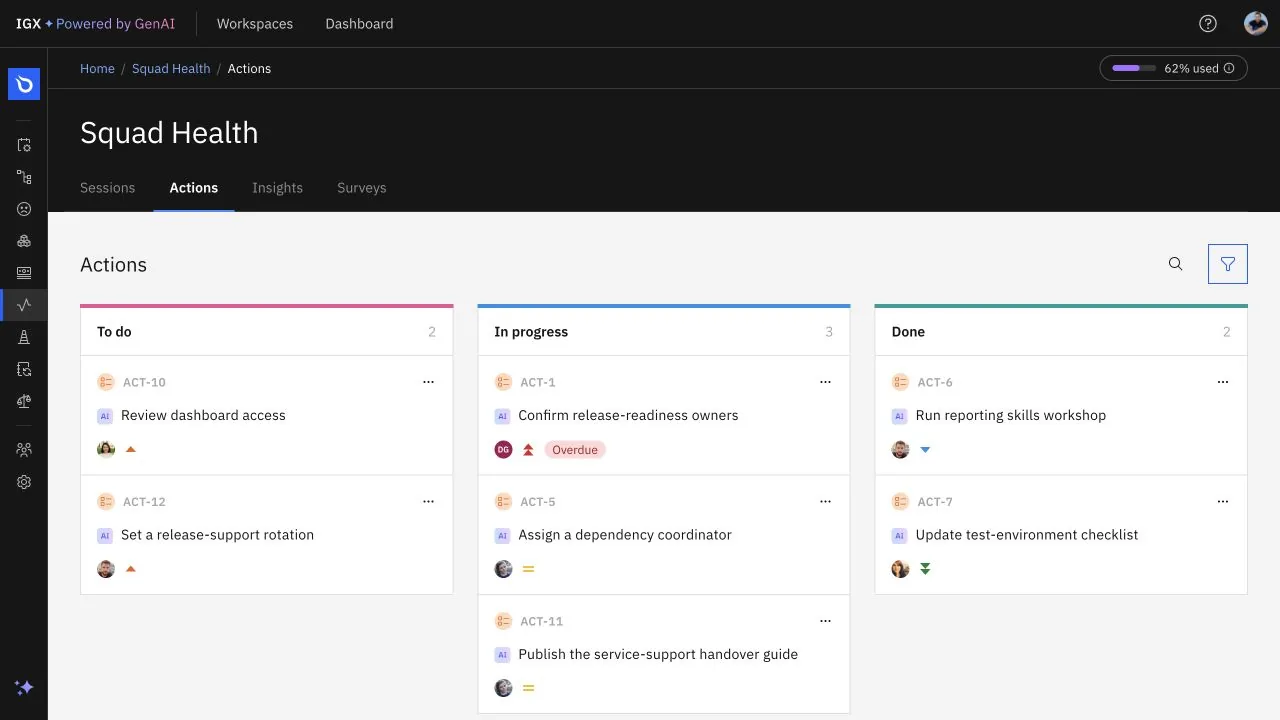
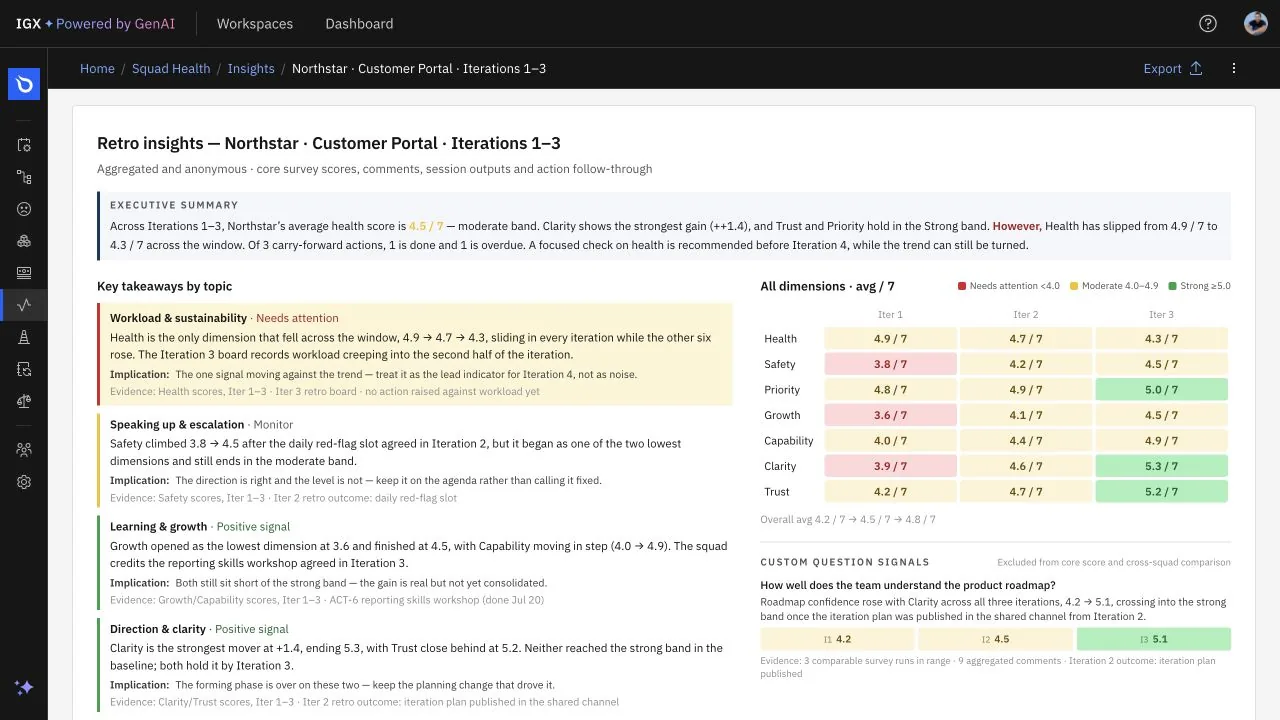
Wrap-up accepts boards, notes, and supporting files, then drafts a reviewable outcome set. A session cannot close on a vague commitment: retained Actions need a clear owner and due date. Across iterations, the same evidence becomes an aggregated insight report for Garage leads.

  • Upload existing materials in the team's format, then review and refine the AI extraction.
  • Carry agreed commitments into Actions with status, owner, and due date.
  • Report trends, topic takeaways, action follow-through, and the next focus across multiple iterations.
Wrap-up view that accepts meeting materials and prepares outcomes for review
Wrap-up · upload, analyse, review
Squad Health Actions board with to-do, in-progress, and done commitments
Actions · an owner and due date before close
Cross-iteration leadership insight report with scores, takeaways, evidence, and action follow-through
Insights · an aggregated report for Garage leads

AI-native delivery, deliberately controlled

AI accelerated the build; people kept ownership of the product decisions.

I used an AI coding agent and Figma MCP to turn the design contract into a high-fidelity React prototype, then used the running product to make review concrete. Every material change belonged in both the interaction rule and the implementation—not in a slide note after the fact.

The build contract

Define the states before asking AI to render them.

  1. Specify the lifecycle.Session setup, anonymous delivery, collecting, pre-read, meeting, wrap-up, Actions, and Insights each had explicit states and rules.
  2. Build against source truth.Figma key frames, page specifications, interaction matrices, and source assets constrained the implementation.
  3. Review the running product.Feedback changed a rule, its screen state, and its code path together—then became part of the handoff.

A real build trail

Working code left reviewable receipts.

The prototype repository records product decisions as implementation changes—not just visual snapshots.

mainIGX-new-squad-health
  1. 5810747Build anonymous member survey flow
  2. 5c08e2fMeeting: facilitator-run voting, sticky reactions, participant view
  3. 38995acExpand Squad Health participation and meeting flows
  4. 2fabab1Add member meeting link flow
  5. 60de9bePreserve meeting and action scope

Working prototype walkthrough · 41 seconds

Configuration, participant upload, and survey setup in a running prototype.

This is the reviewable artifact—not a fabricated product film. It lets stakeholders inspect the product behavior behind the screens.

Three multidisciplinary review gates

The work moved forward only when the next decision was clear.

  1. Gate 01

    Frame the service

    Garage coach input turned a survey request into a complete retrospective and learning loop: session, discussion, accountable action, and reporting.

  2. Gate 02

    Stress-test the live workflow

    With the PO and delivery reviewers, the prototype made privacy, participation, meeting flow, voting integrity, and outcome review discussable as real product behavior.

  3. Gate 03

    Review the handoff

    The delivery team, architects, technical leads, PO, and IBM DT Coaches reviewed the runnable prototype and the accompanying rules, specifications, guidelines, and prompts before development handoff.

What I handed over

A runnable product package—not a stack of disconnected design files.

The handoff made the entire health-check lifecycle inspectable: a high-fidelity prototype, the behavior and state rules behind it, a client demo route, review decisions, and the implementation context needed by development. Squad Health is now launched in Garage practices for Garage coach teams.

  • Facilitator, member, and meeting-link prototype paths
  • Session, survey, wrap-up, Actions, and Insights lifecycle coverage
  • Page specifications, interaction matrices, and design guidelines
  • AI prompts, demo fixtures, and implementation context for development

What the prototype deliberately proved

One team signal can become an accountable action and a leadership-level learning trail.

It made the chain from setup and anonymous responses through AI preparation, facilitated discussion, external-material analysis, reviewed outcomes, Actions, and cross-iteration reporting demonstrable in one product.

What production still needs

Real services, not simulated certainty.

Identity and permissions, server-side scheduling and delivery, cross-client sync, audit history, production AI responses, and validation with live Garage teams remain production work—not claims made by the prototype.

Reflection

The hard part was not producing a better score. It was making the team’s next decision trustworthy.

AI accelerated the path from design rules to a reviewable product, but it did not replace design judgment. The work required explicit boundaries for privacy, facilitation, voting, ownership, and the things the prototype could not yet claim to solve.